
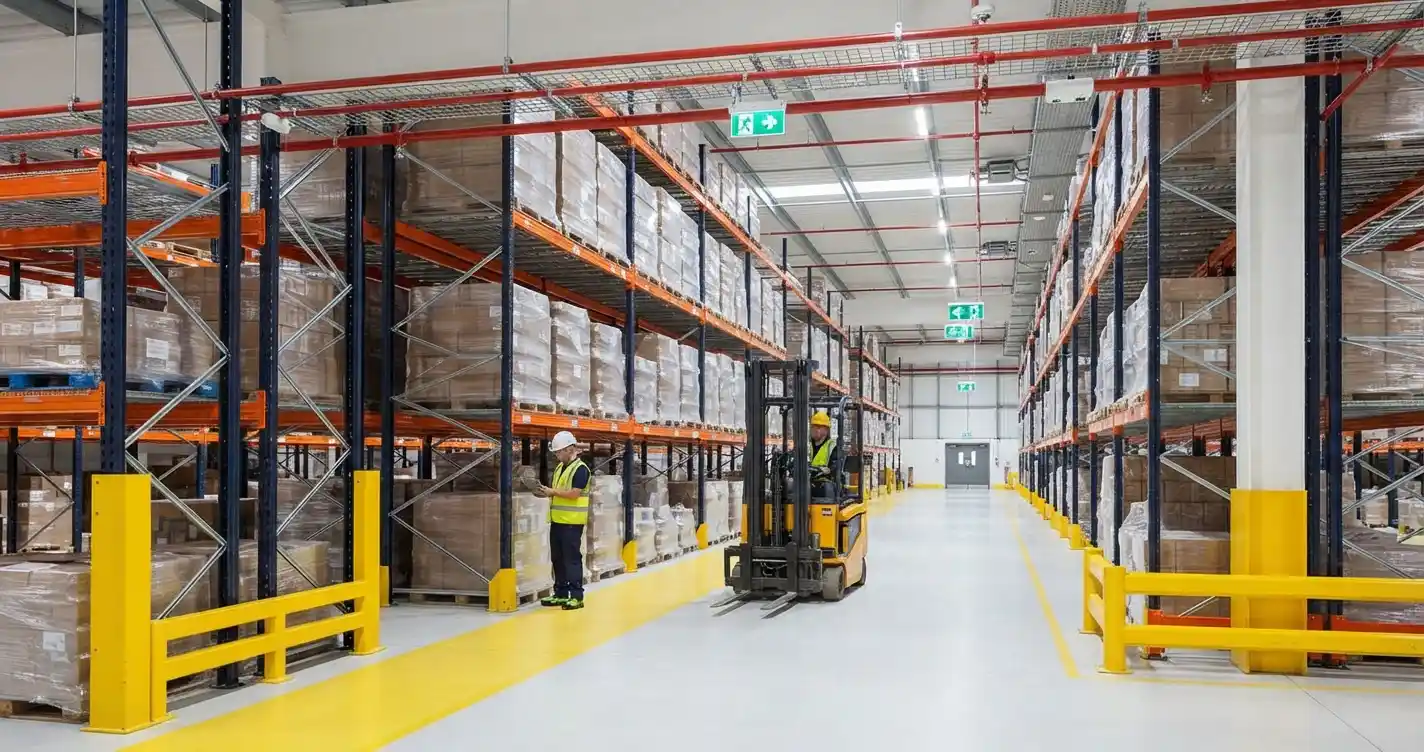
Warehouse Safety Requirements: Top 7 Structural Safety Standards and Civil Defense Regulations
Any accident inside a warehouse—whether it is a rack collapse, a fire, or a forklift collision—doesn’t just cost you the goods; it can halt operations for weeks and put workers at risk. For this reason, warehouse safety requirements are no longer merely bureaucratic checkboxes to finalize a license, but the very foundation of business continuity.
In this article, we explain from a practical standpoint what logistics warehouses need in terms of design, storage, and fire protection, and clarify how to ensure your warehouse is truly compliant.
What Are Warehouse Safety Requirements?
They are a set of engineering and operational rules that ensure the building, storage systems, and equipment operate safely. They are divided into three main pillars:
Structural Safety: The building’s and racks’ capacity to bear designated loads.
Fire Protection: Alarm, firefighting, and evacuation means.
Operational Safety: The movement patterns of workers and equipment, and how goods are stored.
Regulatory authorities, led by Civil Defense, inspect these three pillars during licensing and periodic inspections. Complying with them from the start is far cheaper than modifying the warehouse after a license is denied.
The Top 7 Structural Safety Standards in Warehouses
1. Designing Storage Racks According to EN 15512
EN 15512 is the European standard for the design of adjustable pallet racking systems. It defines how load-bearing capacity, bending resistance, and lateral stability are calculated. When purchasing a storage system, ask the supplier for design documents and structural calculations—do not settle for a mere “compliant with specifications” declaration.
2. Clear Load Capacity Plaques on Every System
A plaque showing the maximum load per level and per bay must be firmly fixed to the racks, and every forklift operator must be fully aware of it. Most rack collapse accidents start with overloading or uneven load distribution, rather than a defect in the steel itself.
3. Racking Anchorage and Floor Inspection
A good rack is useless if the concrete floor is weak or uneven. You must verify the concrete thickness and its ability to withstand upright column pressure, ensure base plates are anchored with appropriate heavy-duty bolts, and check that there is no noticeable slope in the floor.
4. Upright Protectors and Aisle-End Guards
The most frequent cause of warehouse rack damage is forklift collisions with uprights. Even a minor impact can bend a column and weaken its load capacity unnoticed. Therefore, column protectors should be installed at the base, along with safety guards at aisle ends. This is a small investment compared to the cost of replacing a column or fixing a leaning rack.
5. Wire Decking for Storage and Fire Safety
Wire mesh decks are installed over beams to support pallets and prevent small items from falling through gaps. However, their most critical safety value is allowing sprinkler water to reach lower levels, whereas solid boards block the water and let fires spread underneath. They also promote airflow and facilitate visual inspections. Always make sure they can support the rated load of each level.
6. Periodic Inspection According to EN 15635
Proper design alone is not enough; racks suffer wear and tear with daily use. EN 15635 mandates regular visual inspections and more detailed checks by a qualified person. It is recommended to categorize damages using a traffic-light system (green, yellow, red) to determine what requires monitoring versus what needs to be unloaded immediately.
7. Cargo Distribution and Storage Heights
Place the heaviest items at the bottom and the lightest at the top, never exceed the permitted height, and do not store goods protruding beyond the pallet boundaries. Furthermore, operators must be trained to place pallets precisely in their locations, as crooked placement alters the load distribution on the beams.
Civil Defense Requirements for Warehouses
Civil Defense requirements for warehouses vary in detail from one country to another and depend on the type of activity and stored goods; therefore, always consult the approved local code before designing. However, common elements appear across most regulations:
Alarm and Automatic Fire Suppression Systems: Smoke or heat detectors, acoustic alarms, and a sprinkler system designed according to the type of goods and storage height must be available. Many projects reference standards like NFPA 13 for sprinkler design. Also, remember that high-bay racks may require in-rack sprinklers, not just ceiling ones.
Clearance Distances Between Racks and Sprinklers: Sufficient clearance must be left between the top of the cargo and the sprinklers to ensure proper water distribution. Vertical gaps (flue spaces) must also be maintained between pallet rows to allow water and air to pass. These details are what inspectors check first.
Emergency Exits and Aisles: Exits must be visible, unobstructed, and equipped with emergency lighting and clear directional signage. Aisle widths must not fall below the required minimum and should never be used as temporary storage space—even if it’s “just for an hour.”
Fire Extinguishers and Fire Hoses: Extinguishers should be distributed according to the warehouse area and hazard type, and they must be periodically inspected and serviced. Workers must know their locations and how to use them, as training is just as vital as having the equipment.
Common Mistakes That Cause License Rejection or Accidents
Modifying rack layouts or beam heights without consulting the designer.
Using solid wooden or metal boards that block firefighting water.
Neglecting to repair a struck column under the excuse that “it’s still working.”
Storing flammable materials near heat or electrical sources.
Lacking a written log for inspections and maintenance.
How to Ensure Your Warehouse Is Compliant?
Start with a comprehensive field inspection conducted by a specialized engineer, then compare the results with relevant standards and the local building code. It is helpful to keep a single master file containing layouts, structural calculations, material certificates, and inspection logs. This file cuts down inspection time and proves to regulatory authorities and insurance providers that you take safety seriously.
When choosing a storage system supplier, ask about the standards used to design the racks, the availability of wire decking and column protectors, and post-installation inspection services.
خلاصة
Warehouse safety requirements are not just administrative burdens; they form an integrated ecosystem starting with rack design according to EN 15512, passing through column protection and wire decking for fire water penetration, and concluding with strict compliance with Civil Defense regulations and periodic inspections. A safe warehouse operates without interruption, protects workers and goods, and gives you peace of mind during every inspection visit.