Industry News

Radio Shuttle Safety Standards: Sensors, Batteries & Maintenance

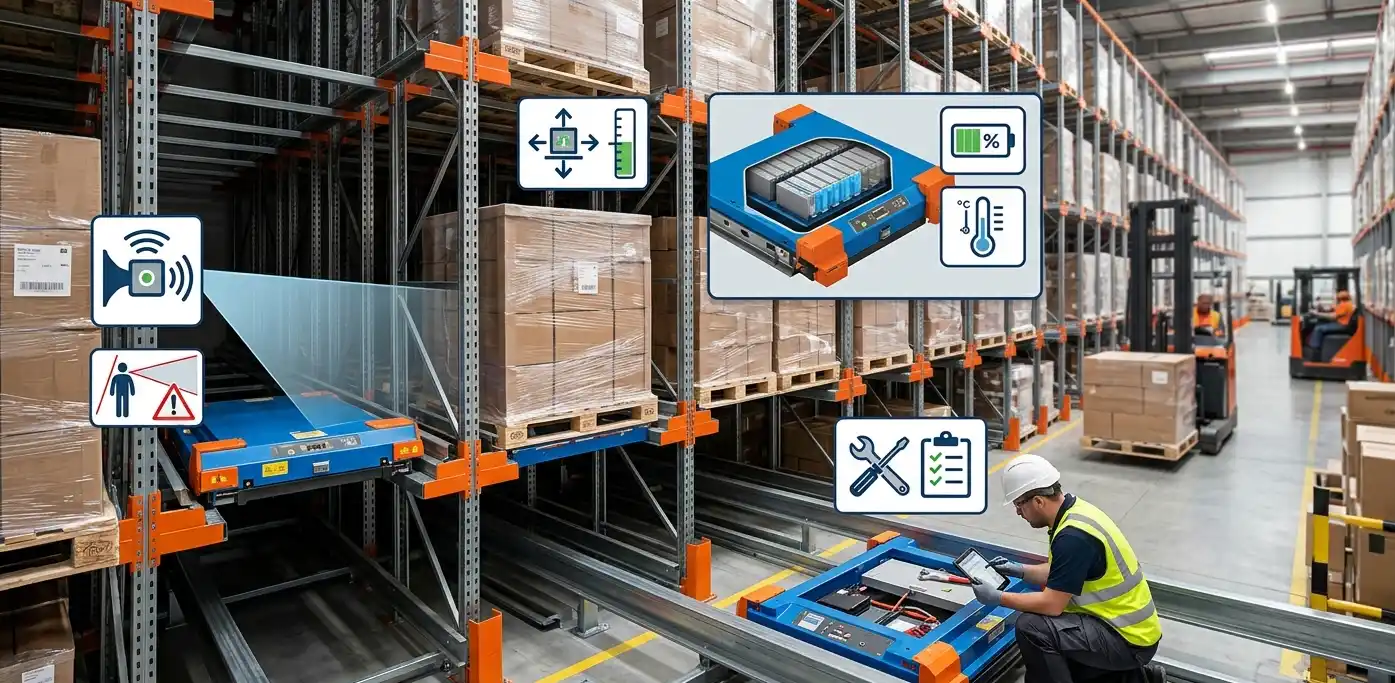
Radio shuttle cart operating in a high-density warehouse automation racking system

Radio Shuttle Safety Standards for Automated Warehouses

Modern warehouses need more than just high storage capacity. Today, companies are looking for systems that can improve efficiency, reduce forklift traffic, and maintain safe, reliable operation under demanding conditions.

This is why Radio Shuttle Systems have become one of the most widely used high-density storage solutions in industries such as cold storage, food distribution, pharmaceuticals, and logistics.

But modern warehouse automation is not only about speed or pallet capacity. Safety standards, battery reliability, sensor accuracy, and emergency recovery procedures all play a critical role in maintaining stable day-to-day operations.

In this guide, we’ll explore the key safety standards for Radio Shuttle Systems, including sensors, batteries, pallet requirements, maintenance practices, and rescue protocols that help reduce downtime and improve operational reliability.

Pallet Shuttle System Applications: From Food to Pharma

Radio Shuttle Systems are widely used across industries that depend on:

  • High-density storage systems
  • Fast pallet handling efficiency
  • FIFO and LIFO inventory management
  • Warehouse space optimization
  • Reduced forklift traffic inside storage lanes
  • Improved warehouse operational efficiency

Because the system minimizes manual movement and increases storage density, it has become a preferred warehouse automation solution for modern distribution environments.

Food & Beverage Industry

The system is ideal for high-turnover inventory such as:

  • Bottled water and beverages
  • Dairy products
  • Frozen foods
  • Seasonal inventory

Automated shuttle systems help warehouses accelerate loading and unloading operations while maintaining faster inventory rotation and reducing forklift congestion.

Pharmaceutical Industry

In pharmaceutical warehouses, accuracy and inventory stability are often more critical than speed.

For this reason, many pharmaceutical companies rely on shuttle-based storage technology because it helps:

  • Reduce manual pallet handling
  • Minimize product and pallet damage
  • Improve inventory tracking accuracy
  • Maintain stable pallet movement inside deep lanes
  • Reduce operational errors in high-volume environments

Logistics & Distribution Centers

3PL providers and distribution centers use Radio Shuttle Systems to increase storage capacity without expanding warehouse space.

This allows businesses to maximize storage density while maintaining faster throughput and reduced warehouse downtime.

Industrial & Chemical Sectors

The system is also suitable for heavy-duty industrial products and fast-moving palletized goods that require stable and reliable storage operations.

Ready to upgrade your warehouse automation? [Contact Zawaya’s technical team today] for an expert consultation and customized pricing.

Operating in Extreme Environments: Cold Storage & Freezers

One of the biggest advantages of modern Radio Shuttle Systems is their ability to operate in harsh warehouse environments such as:

  • Cold rooms
  • Industrial refrigerators
  • Frozen food warehouses
  • Deep freezer storage facilities

Are Radio Shuttle Carts Resistant to Moisture and Corrosion?

Yes. Modern shuttle carts from Zawaya are designed specifically for demanding industrial and cold-storage conditions.

Key features include:

  • Anti-corrosion coating for steel structures
  • IP65-rated insulated electronic components
  • Protection against humidity and condensation
  • Advanced lithium batteries optimized for low-temperature environments

Special cold-storage versions can operate at temperatures as low as:

−30°C

without negatively affecting shuttle speed or battery performance.

Why Are Shuttle Systems Important in Cold Storage?

In refrigerated warehouses, every square meter has a high operating cost because of energy consumption.

Radio Shuttle Systems help improve cold storage automation by:

  • Reducing aisle space requirements
  • Increasing storage density
  • Limiting forklift exposure to freezing environments
  • Accelerating pallet movement and loading operations
  • Improving warehouse space utilization without facility expansion

The result is lower energy consumption, improved workflow, and higher warehouse operational efficiency.

Safety Protocols: Sensors, Emergency Stops & Obstacle Detection

Safety is not an optional feature in automated pallet handling systems — it is a core part of the entire warehouse automation design.

Intelligent Sensor Systems

The shuttle cart uses multiple smart sensors to monitor:

  • Pallet position
  • Direction of movement
  • Distance inside storage lanes
  • Obstacles
  • Load balance and stability

These intelligent systems help prevent collisions while maintaining stable pallet movement even at high operating speeds.

Obstacle Detection System

If the shuttle detects an unexpected object or obstruction inside the lane, the system automatically stops operation to prevent:

  • Product damage
  • Pallet collisions
  • Equipment malfunction
  • Unsafe pallet movement

This feature plays a major role in automated warehouse safety and downtime reduction.

Emergency Stop Functions

The system also includes emergency stop points that allow operators to immediately stop shuttle movement whenever necessary — a critical safety requirement in modern warehouse automation systems.

Automated pallet shuttle system optimizing storage density in a pharmaceutical warehouse

Pallet Quality Standards for Stable Shuttle Operation

Pallet quality is one of the most overlooked factors in high-density storage systems, despite its direct impact on shuttle performance, maintenance, and operational safety.

To ensure maximum efficiency, pallets should meet the following standards:

Requirement

Importance

Intact Bottom Boards

Ensures accurate sensor operation and stable rail movement

Standardized Dimensions

Improves load stability inside deep lanes

Balanced Load Distribution

Maintains a stable center of gravity during movement

Clean Pallet Base

Prevents obstruction and rail interference

Recommended Pallet Dimensions

It is recommended to use standardized pallet sizes such as:1200 × 1000 mm

or standard Euro pallets to maintain safe and stable shuttle movement.

Why Pallet Condition Matters

The pallet base should always be free from:

  • Protruding nails
  • Broken wood sections
  • Loose debris
  • Damaged bottom boards

Even small obstructions can interfere with shuttle movement and increase the risk of operational failure.

The Rescue Protocol: What Happens if a Shuttle Stops Inside the Lane?

This is one of the most important real-world safety topics in automated storage systems — yet many suppliers rarely discuss it.

So what happens if a shuttle suddenly stops inside a deep storage lane?

Step 1: Instant System Alert

If the system detects:

  • Low battery
  • Communication failure
  • An obstacle inside the lane
  • Movement malfunction

an instant alert is automatically sent to the operator through the control unit.

Step 2: Safe Stop Mode

The shuttle does not stop randomly.

Instead, it enters a controlled Safe Stop mode designed to prevent:

  • Pallet collapse
  • Collisions
  • Load instability
  • Unsafe lane blockage

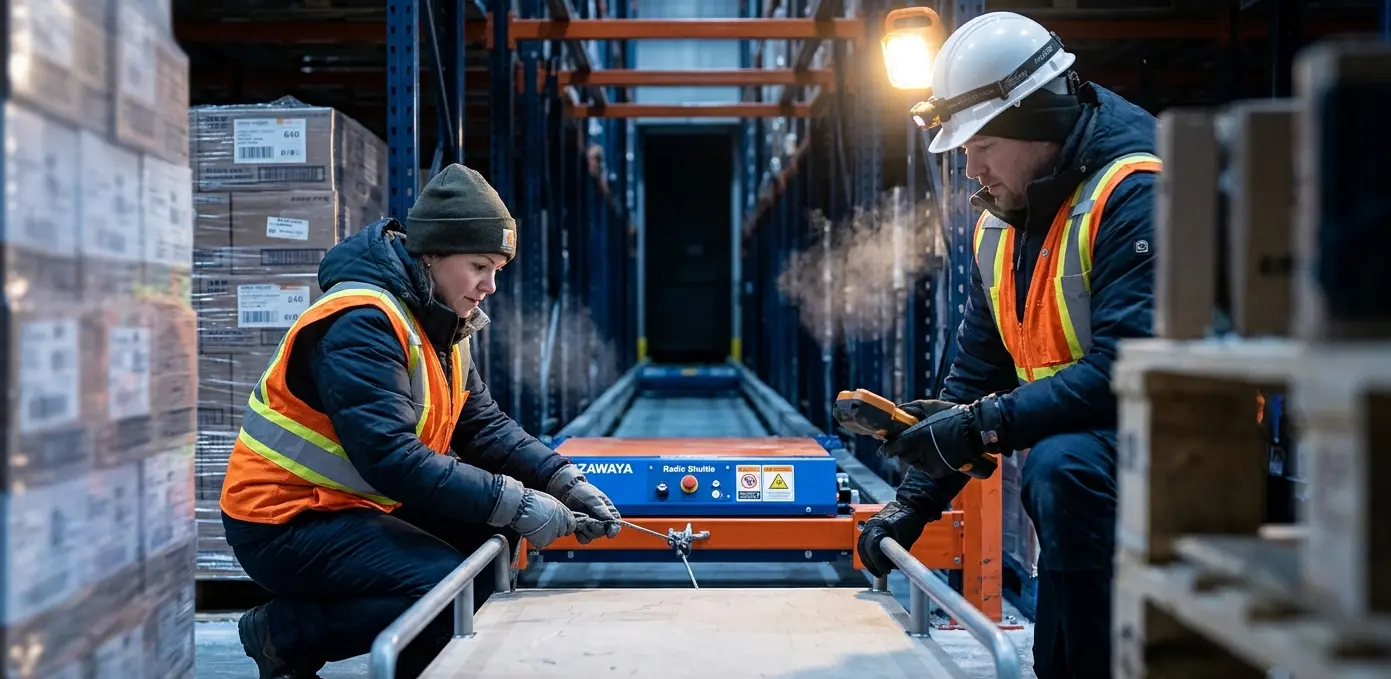
Step 3: Rescue & Recovery Procedure

Professional shuttle systems follow a structured recovery protocol:

  1. Identify the shuttle location inside the lane
  2. Retrieve the shuttle manually or using a rescue cart
  3. Inspect battery status and sensor conditions
  4. Verify lane safety before restarting operation

This process minimizes warehouse downtime while maintaining operational safety without unloading the entire lane.

Maintenance Checklist for Radio Shuttle Batteries & Motors

Every warehouse automation system requires preventive maintenance to ensure long-term performance, reliability, and operational stability.

Battery Inspection

Operators should regularly monitor:

  • Battery charge level
  • Charging cycles
  • Battery temperature
  • Discharge rate

Weak batteries can directly affect shuttle speed, movement accuracy, and operational stability.

Motor Inspection

Maintenance teams should routinely check for:

  • Abnormal vibrations
  • Reduced movement efficiency
  • Unusual noise or friction
  • Wheel performance issues

Sensor Cleaning

Dust, moisture, and condensation can affect sensor accuracy over time.

For this reason, sensors should be cleaned regularly, especially in heavy industrial and cold-storage environments.

Rail & Lane Inspection

Rail misalignment or structural damage may lead to:

  • Shuttle movement failure
  • Increased wheel wear
  • Unexpected system shutdowns
  • Reduced automation efficiency

Preventive Maintenance Reduces Downtime

The real goal of maintenance is not only fixing problems — but preventing them before they occur.

This is why advanced warehouses rely on preventive maintenance schedules to maintain:

  • Stable long-term operation
  • Longer battery life
  • Higher automation efficiency
  • Reduced emergency repairs
  • Lower operational downtime

Why Safety Standards Matter in Modern Radio Shuttle Systems

Warehouse downtime is extremely expensive in modern supply chains.

Even small operational failures can affect:

  • Shipping schedules
  • Production flow
  • Supply chain continuity
  • Delivery performance
  • Inventory accuracy

As a result, companies are no longer searching only for high-density storage solutions.

They need systems that are:

  • Safe
  • Reliable
  • Easy to maintain
  • Suitable for harsh environments
  • Designed with intelligent safety systems
  • Equipped with professional rescue protocols

This is why Radio Shuttle Systems have become one of the most advanced solutions for warehouse automation and deep-lane pallet storage.

To learn more about our advanced storage engineering and complete product specifications, you can [Download Zawaya’s Company Profile] to explore our full range of automated warehousing systems.

الأسئلة الشائعة

Can Radio Shuttle Systems Operate Inside Freezers?

Yes. Special cold-storage shuttle versions are designed for refrigerated and frozen warehouse environments with protection against humidity, condensation, and low temperatures.

Does the System Require Specific Pallet Types?

Yes. Standardized pallets with proper dimensions and intact bottom boards are recommended to ensure accurate sensor operation and stable shuttle movement.

What Happens if the Shuttle Stops Inside the Lane?

The system activates a structured rescue protocol that includes Safe Stop mode, operator alerts, shuttle retrieval, and safety inspection before restarting operation.

Is Radio Shuttle Maintenance Complicated?

Not necessarily. However, regular preventive maintenance for batteries, motors, sensors, and rails is essential for long-term performance and warehouse operational reliability.

How Do Radio Shuttle Systems Improve Warehouse Safety?

They reduce forklift traffic inside storage lanes, minimize manual pallet handling, improve obstacle detection, and maintain controlled pallet movement inside deep storage systems.