Lower Forklift Usage and Maintenance Costs
Forklifts are one of the most expensive ongoing operational assets inside a warehouse.
The costs go far beyond the purchase price itself.
Warehouses must also manage:
- Battery charging
- Tire replacement
- Maintenance schedules
- Equipment downtime
- Operator safety
- Fuel or electricity consumption
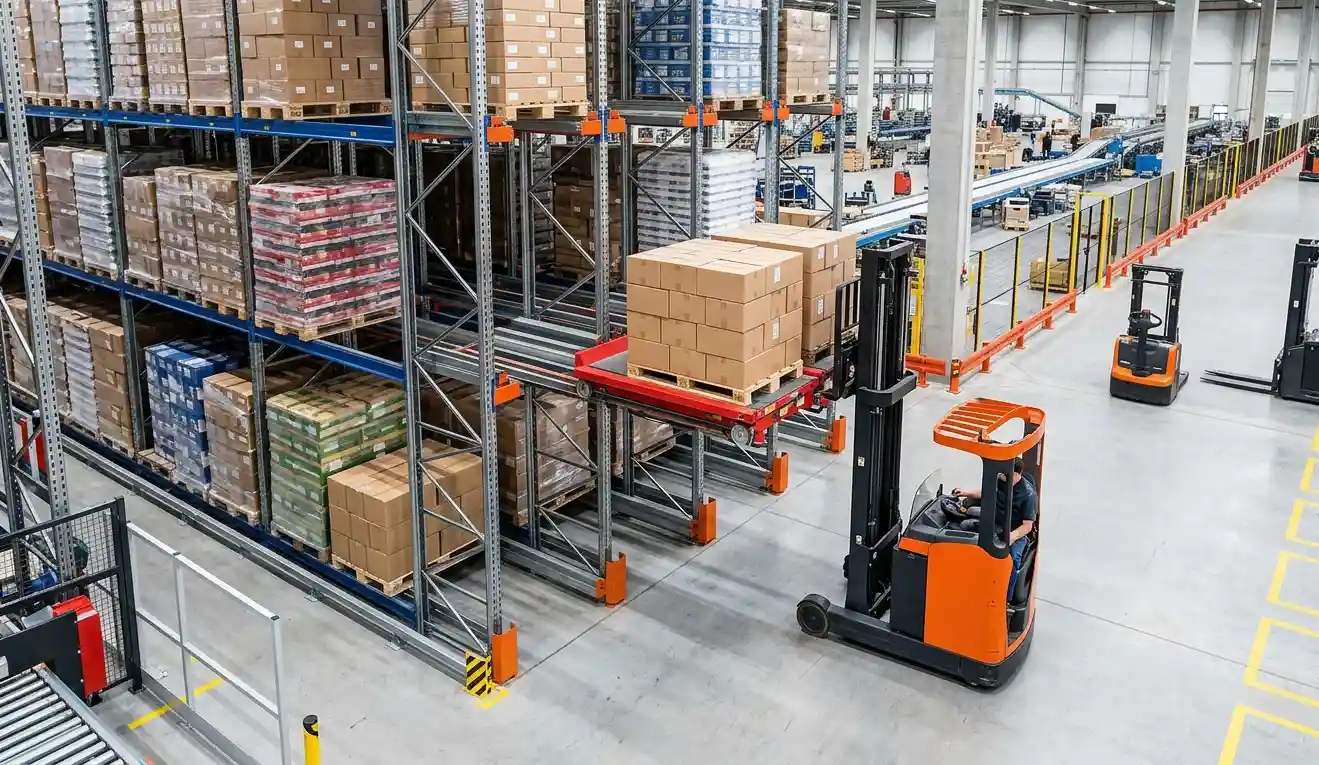
In traditional systems, forklifts travel constantly throughout the warehouse, increasing wear and maintenance requirements.
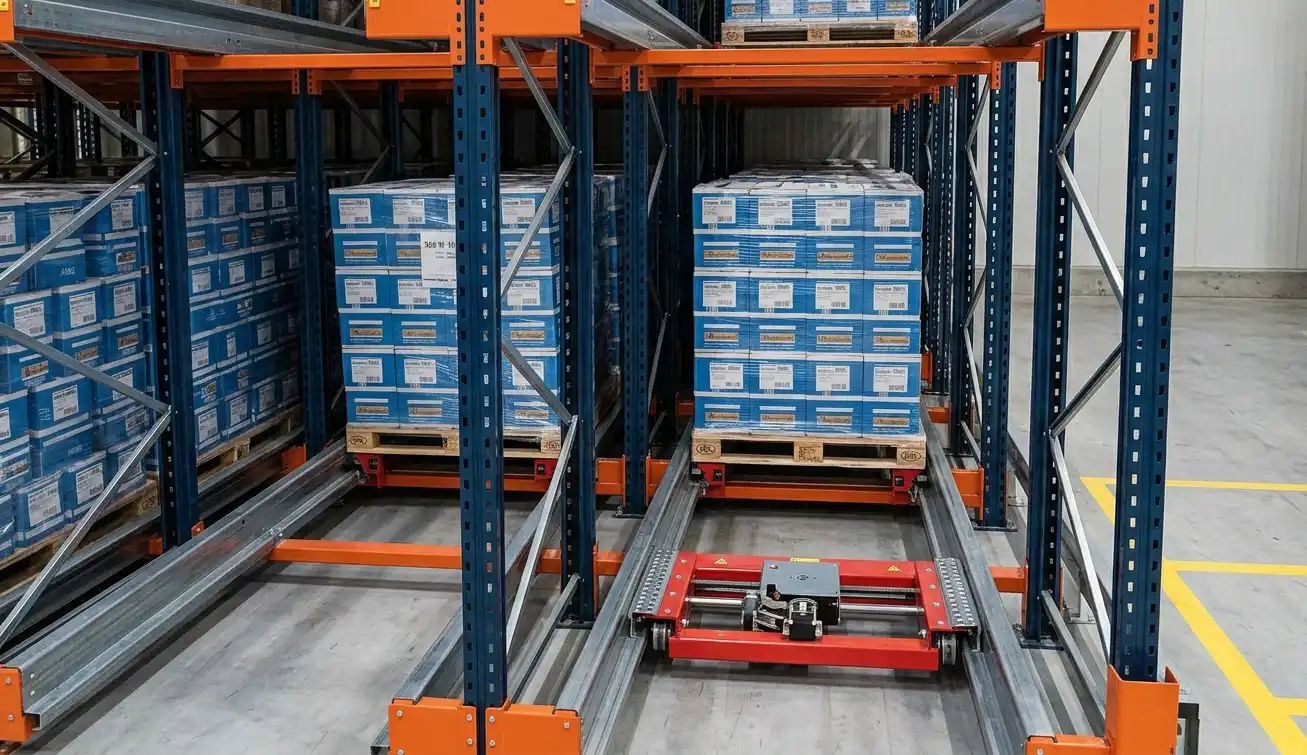
Pallet Shuttle systems reduce unnecessary forklift travel because internal pallet movement is handled by the shuttle.
This helps companies achieve:
- Lower forklift maintenance costs
- Reduced battery consumption
- Longer equipment lifespan
- Smaller forklift fleets
- Less rack collision damage
Over several years, these savings can become substantial.
Reducing Product Damage and Warehouse Interruptions
Product damage is often one of the most underestimated warehouse expenses.
In busy warehouse environments, repeated pallet handling increases the risk of:
- Crushed packaging
- Unstable pallet loads
- Rack damage
- Inventory loss
- Shipment delays
Forklift traffic inside narrow aisles also increases the likelihood of operational interruptions and safety incidents.
Because the Pallet Shuttle System minimizes direct forklift interaction inside storage lanes, handling becomes safer and more controlled.
Warehouses often experience:
- Fewer rack collisions
- Lower pallet damage
- Improved inventory protection
- Reduced downtime
- More stable operations during peak activity
These improvements help protect both inventory value and operational continuity.
Why Pallet Shuttle Systems Perform Especially Well in Cold Storage
Cold storage warehouses face unique operational challenges.
Every cubic meter inside a refrigerated facility directly affects energy consumption.
Large open aisles, unnecessary movement, and underutilized storage space increase cooling costs significantly.
Pallet Shuttle systems improve cold storage efficiency by maximizing storage density and reducing wasted space.
This allows warehouses to store more pallets within a smaller refrigerated area.
Additional operational advantages include:
- Reduced cooling loss
- Lower lighting requirements
- Faster loading operations
- Improved energy efficiency
- Better use of refrigerated space
For cold storage facilities operating continuously, these savings can have a major impact on long-term profitability.
Pallet Shuttle vs Selective Racking
Both systems offer valuable advantages depending on warehouse requirements.
Selective Racking remains an excellent solution for warehouses that require:
- Direct access to every pallet
- High SKU diversity
- Flexible inventory management
- FIFO operations
- Lower initial investment
It is particularly suitable for warehouses handling many different products in smaller quantities.
However, as warehouse throughput increases, operational limitations become more visible.
Selective systems require:
- More aisles
- More forklift movement
- More labor
- More operational space
Pallet Shuttle systems, on the other hand, are designed for high-density storage and high-volume pallet movement.
They become especially effective when warehouses prioritize:
- Maximum storage capacity
- Faster throughput
- Lower operational costs
- Reduced forklift traffic
- Long-term scalability
For many growing logistics operations, the shift toward shuttle automation becomes a natural next step as operational demands increase.
Real-World Example of Long-Term Operational Savings
A logistics company operating a large multi-shift warehouse implemented a Pallet solution to improve storage capacity and reduce operational inefficiencies.
Before installation, the warehouse faced several challenges:
- Congested forklift traffic
- Rising labor costs
- Limited storage density
- Frequent rack damage
- Slow pallet movement during peak operations
After implementing the system, the company achieved noticeable operational improvements.
The warehouse required fewer forklift operators, pallet flow became faster, and available storage capacity increased significantly within the same facility.
The company also reduced maintenance expenses and experienced fewer product handling incidents.
Within a relatively short period, the operational savings generated by the system were substantial enough to offset a large portion of the initial investment.
This is one of the main reasons why many logistics companies view Pallet Shuttle systems as long-term operational investments rather than simple storage equipment.
When Does Selective Racking Become Less Efficient?
Selective Racking performs extremely well in many warehouse environments.
However, operational limitations often appear as warehouse activity grows.
Over time, companies may begin facing:
- Limited storage density
- Congested forklift movement
- Higher labor dependency
- Slower throughput
- Increasing operational expenses
At this stage, maintaining operational efficiency becomes more difficult without introducing higher-density automation solutions.
This is where Pallet Shuttle systems often provide stronger long-term value.
By improving storage efficiency while reducing repetitive operational costs, the system helps warehouses scale more effectively without dramatically increasing operating expenses.
Is a Pallet Shuttle System a Good Long-Term Investment?
For many high-volume warehouse operations, the answer is yes.
The system is especially valuable for:
- Logistics centers
- Distribution hubs
- Cold storage facilities
- Manufacturing warehouses
- Warehouses operating multiple shifts
The long-term value comes from continuous operational improvements rather than short-term savings alone.
Over time, companies benefit from:
- Better warehouse productivity
- Lower operational costs
- Higher storage capacity
- Improved inventory flow
- Reduced equipment strain
- Greater scalability
As warehouse automation continues evolving, many companies now view shuttle systems as part of a broader long-term strategy for operational efficiency and future growth.
FAQ
How Long Does It Usually Take to Recover the Cost of a Pallet Shuttle System?
The recovery period depends on warehouse size, labor costs, operational volume, and storage requirements.
However, many high-throughput warehouses begin seeing significant operational savings within the first few years due to reduced labor, improved storage density, and lower forklift usage.
Is Pallet Shuttle Better Than Traditional Selective Racking?
Not necessarily in every situation.
Selective Racking remains highly effective for warehouses requiring direct pallet access and high SKU flexibility.
Pallet Shuttle systems become more advantageous in warehouses focused on high-density storage, automation, and long-term operational efficiency.
Can a Pallet Shuttle System Reduce Warehouse Labor Costs?
Yes.
Because the system automates internal pallet movement, warehouses often require fewer forklift operations and less repetitive manual handling.
This can significantly improve labor efficiency over time.
Why Are Pallet Shuttle Systems Popular in Cold Storage Warehouses?
Cold storage facilities benefit heavily from higher storage density and reduced open refrigerated space.
By maximizing pallet capacity within the same footprint, Pallet Shuttle systems help improve cooling efficiency and reduce long-term energy consumption.
What Is the Biggest Advantage of a Pallet Shuttle System?
For many companies, the biggest advantage is the combination of:
- Higher storage capacity
- Faster warehouse throughput
- Lower operational costs
- Reduced forklift dependency
- Better long-term scalability
Together, these improvements create stronger long-term warehouse efficiency and higher operational ROI.