
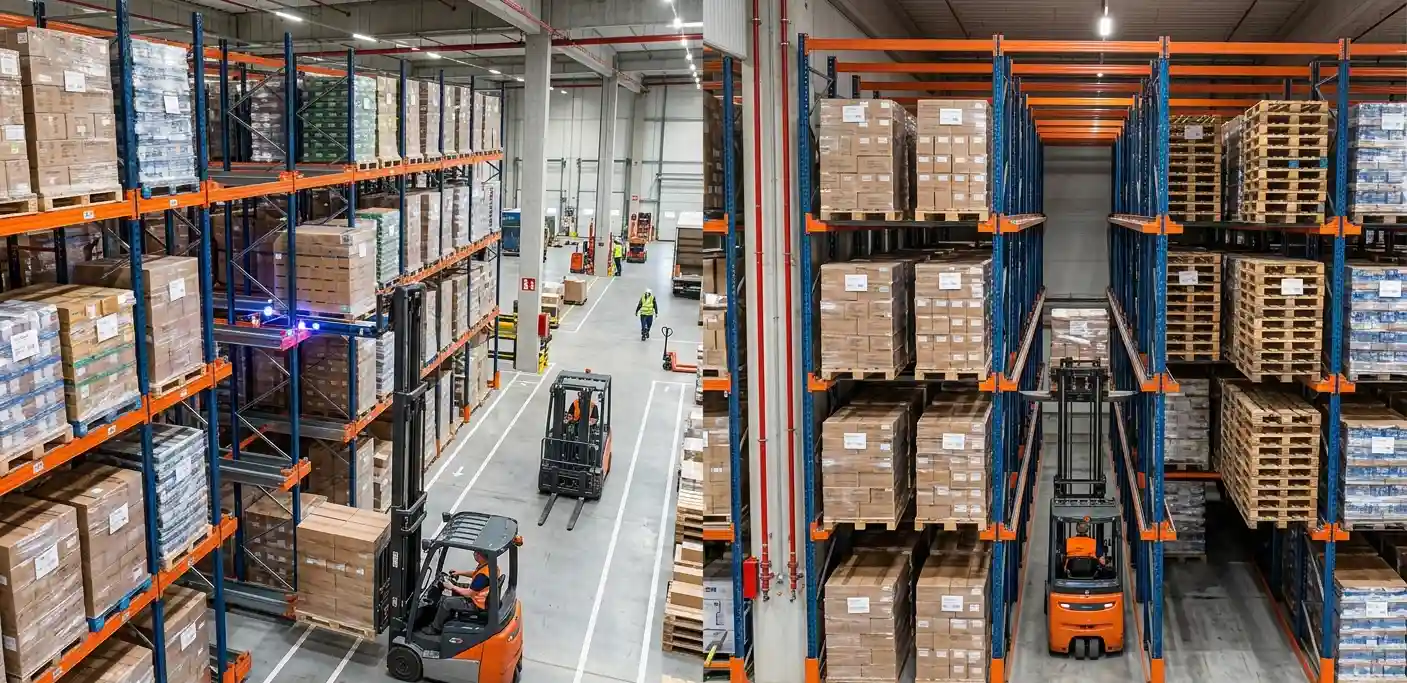
Radio Shuttle vs Drive-in: Best Warehouse Storage System Comparison
Choosing the right warehouse storage system is no longer just about adding more racks or finding the lowest installation cost.
Today, a poor storage layout can directly impact:
- warehouse productivity,
- forklift movement efficiency,
- pallet accessibility,
- space utilization,
- and even the overall performance of the supply chain.
As modern warehouses face increasing pressure to achieve higher storage density with faster inventory movement, many businesses are starting to rethink traditional systems like Drive-in Racking and move toward smarter automation-ready solutions such as Radio Shuttle Racking Systems.
But the real question is:
Can traditional Drive-in Racking still meet the demands of modern high-density warehouses?
Or have Pallet Shuttle Systems become the more efficient long-term solution?
In this guide, we’ll compare Radio Shuttle vs Drive-in Racking from a real operational perspective — including:
- pallet accessibility,
- storage density,
- forklift requirements,
- warehouse safety,
- operational costs,
- and future automation readiness.
We’ll also explain why modern 2D Pallet Shuttle Systems are rapidly changing the future of high-density warehouse storage across logistics centers, industrial facilities, and cold storage warehouses.
What Is Drive-in Racking?
Drive-in Racking is one of the most widely used high-density storage systems in modern warehouses.The system works by allowing forklifts to drive directly inside rack lanes to place or retrieve pallets.It is commonly used in:
- Cold storage warehouses
- Facilities with limited SKU variations
- Low-rotation inventory
- LIFO storage operations
Key Advantages of Drive-in Racking
- Lower initial investment cost
- Good storage density
- Reduced aisle requirements
- Simple warehouse layout
However, as warehouse operations become faster and more demanding, Drive-in systems often face operational limitations related to:
- forklift traffic,
- rack damage,
- safety risks,
- and slower pallet handling efficiency.
What Is Radio Shuttle Racking?
Radio Shuttle Racking, also known as a Pallet Shuttle System, is a semi-automated warehouse storage solution that uses an intelligent shuttle cart to move pallets automatically inside storage channels.Instead of forklifts entering the rack structure:
- the forklift places the shuttle at the channel entrance,
- and the shuttle automatically stores or retrieves pallets.
This significantly reduces:
- forklift travel time
- rack collisions
- structural damage
- and workplace accidents.
At the same time, it improves:
- pallet handling speed
- storage density
- operational efficiency,and warehouse throughput.
Because of these advantages, Radio Shuttle Systems are becoming one of the fastest-growing solutions in automated warehouse storage.
Main Differences in Accessibility and Speed
Radio Shuttle vs Drive-in: Pallet Accessibility Comparison
One of the biggest operational differences between the two systems is pallet accessibility and loading speed.
In Drive-in Racking
- Forklifts must enter storage lanes
- Movement becomes slower
- Operators often wait between cycles
- Maneuvering becomes difficult in large warehouses
This can lead to:
- lower warehouse productivity,slower loading and unloading,traffic bottlenecks,and reduced operational efficiency during peak hours.
In Radio Shuttle Systems
The shuttle moves pallets automatically inside channels with consistent speed and precision.
As a result:
- pallet loading becomes faster,handling cycles become shorter,fewer forklifts are needed,and warehouse flow becomes significantly more efficient.
Why Is Radio Shuttle Faster?
Because forklift movement stays outside the rack structure, warehouses experience:
- less maneuvering time,
- fewer operator errors,
- lower congestion,
- and smoother workflow automation.
In many modern warehouse projects, Radio Shuttle Racking can deliver nearly double the handling speed of traditional Drive-in systems.That’s why many companies now conduct a Warehouse Storage Assessment before choosing between Drive-in and Shuttle systems — to identify which solution delivers the best long-term operational performance.
Space Utilization Efficiency: Density vs. Flexibility
Comparing Warehouse Space Optimization
Both systems are designed to maximize warehouse storage density by reducing aisle space.
However, they achieve this in very different ways.
| Feature | Drive-in Racking | Radio Shuttle |
|---|---|---|
| Storage Density | High | Very High |
| Operational Flexibility | Limited | High |
| Aisle Requirements | Low | Lower |
| SKU Management | More Difficult | Easier |
| FIFO / LIFO Support | Mostly LIFO | Both FIFO & LIFO |
Why Does Radio Shuttle Offer Better Efficiency?
Because it allows:
- deeper storage channels,
- independent pallet movement,
- improved inventory control,
- and safer long-channel operations.
Modern shuttle systems may also support:
- Multi-Deep Storage
- Smart Inventory Tracking
- WMS Integration
- IoT Warehouse Monitoring
- Automated Pallet Positioning
These technologies are increasingly used in smart warehouses and automated logistics centers worldwide.
Forklift Compatibility and Aisle Requirements
Comparing Forklift Operations in Both Systems
In Drive-in Racking
- Forklifts operate inside rack lanes
- High driving precision is required
- Rack collision risks increase
- Rails experience continuous wear
In Radio Shuttle Racking
- Forklifts stay outside storage channels
- No direct entry into the rack structure
- Significantly lower equipment damage
Operational Impact
Drive-in Systems Often Result In:
- frequent rail damage,
- higher maintenance costs,
- faster forklift wear,
- and more downtime.
Radio Shuttle Systems Offer:
- longer rack lifespan,
- reduced maintenance,
- improved warehouse safety,
- and lower long-term operating costs.
2D Pallet Shuttle: A Technical Leap Beyond Traditional Systems
What Is a 2D Shuttle System?
A 2D Pallet Shuttle System represents the next generation of intelligent warehouse automation.Unlike traditional shuttles that only move forward and backward, 2D systems can move:
- longitudinally,and laterally between channels.
This creates a warehouse system that is:
- more flexible,more scalable,and significantly smarter.
Why Are 2D Shuttle Systems Important?
Because they reduce dependence on:
- manual intervention
- operator errors
- forklift congestion
- and inefficient pallet movement.
At the same time, they improve:
- warehouse response speed
- inventory accuracy
- automation scalability
- and smart warehouse integration.
Advanced Technologies Used in Modern Shuttle Warehouses
- AI-based pallet positioning
- Automated inventory movement
- Real-time warehouse analytics
- Energy-efficient shuttle systems
- AS/RS integration
- Smart warehouse management systems
These technologies are becoming increasingly important for businesses aiming to modernize their supply chain operations and future-proof their warehouses
Which System Offers Higher Safety for Warehouse Personnel?
Warehouse Safety Comparison
Safety has become a major factor in:
- industrial warehouses,
- food storage facilities,
- logistics centers,
- and cold storage operations.
Risks Associated with Drive-in Racking
Because forklifts operate inside rack structures:
- collision risks are higher,
- upright damage is common,
- and pallet fall risks increase.
Safety Advantages of Radio Shuttle Systems
Since forklifts remain outside storage lanes:
- accidents are reduced,
- structural damage becomes less frequent,
- and warehouse operations become more stable.
Some warehouse operators report up to 80% less rack damage after switching from traditional Drive-in systems to Radio Shuttle solutions.
Operational Cost: Which One Saves More Money?
Long-Term Cost Comparison
At first glance, Drive-in Racking may appear cheaper.
However, the real cost difference becomes visible during long-term warehouse operations.
Drive-in Racking
- Higher maintenance costs
- Frequent rack repairs
- Increased forklift wear
- Slower pallet handling
Radio Shuttle Racking
- Higher initial investment
- But better operational efficiency
- Lower labor requirements
- Reduced maintenance
- Faster warehouse throughput
That’s why many companies now evaluate warehouse systems using:
Total Cost of Ownership (TCO)Instead of focusing only on the initial purchase price.
Which Racking System Is Better for Modern Warehouses?
If your warehouse:
- handles high daily pallet movement,
- requires fast loading operations,
- uses FIFO inventory management,
- aims to reduce human error,
- or plans future warehouse automation,
then Radio Shuttle Racking is often the better long-term investment.
However, if:
- budget is limited,
- inventory movement is relatively low,
- and SKU variety is small,
then Drive-in Racking may still be a cost-effective solution.
Before making a final decision, companies should compare:
- daily warehouse throughput,
- pallet quantity,
- inventory turnover,
- forklift type,
- and future expansion plans.
Because choosing the right warehouse storage system impacts far more than space alone — it directly affects productivity, safety, scalability, and operational costs for years to come.
FAQ
Which system is more cost-effective: Drive-in or Pallet Shuttle?
Drive-in Racking has a lower upfront cost, but Pallet Shuttle Systems usually provide better long-term ROI because they:
- reduce rack damage,
- improve warehouse speed,
- lower labor costs,
- reduce forklift usage,
- and minimize maintenance expenses.
Can an existing Drive-in system be converted into a Shuttle System?
Yes.
Many warehouses use a retrofitting process to modify existing rails and adapt them for modern shuttle carts, reducing the need for a completely new rack structure.
Does Radio Shuttle support FIFO inventory management?
Yes.
Radio Shuttle Systems can be configured for both:
- FIFO (First In, First Out)
- and LIFO (Last In, First Out)
depending on warehouse requirements.
Is Radio Shuttle suitable for cold storage warehouses?
Absolutely.
Radio Shuttle Systems are highly effective in cold storage environments because they reduce forklift movement inside refrigerated areas and improve operational efficiency.
The Strategic Shift
The comparison today is no longer simply between:
“traditional racks” and “modern racks.”
It is a comparison between:
- slow manual warehouse operations,
- and scalable intelligent warehouse systems designed for automation.
That’s why technologies such as:
- Radio Shuttle Racking,
- 2D Shuttle Systems,
- and AS/RS Warehouse Solutions
are becoming essential components of modern high-density warehouses.
Whether you are building a new warehouse or upgrading an existing facility, the decision between Radio Shuttle vs Drive-in Racking should be based on real operational requirements — not just initial installation cost.
The best warehouse storage solution today is the one that delivers:
- higher storage density,
- faster pallet movement,
- lower operational costs,
- and long-term automation scalability.