
In the demanding world of warehousing and logistics, operational efficiency is the true currency of success. If you manage a facility with a diverse range of products (SKUs), your biggest challenge isn’t just finding floor space—it’s the speed of accessing every single pallet without wasting time. This is where the industry turns to a fundamental question: what is selective racking and how can it transform your storage capabilities?
In this guide, we will break down what makes this system indispensable and compare it to advanced technologies like the Radio Shuttle system to help you determine the best path for your business growth.
What is a Selective Pallet Rack?
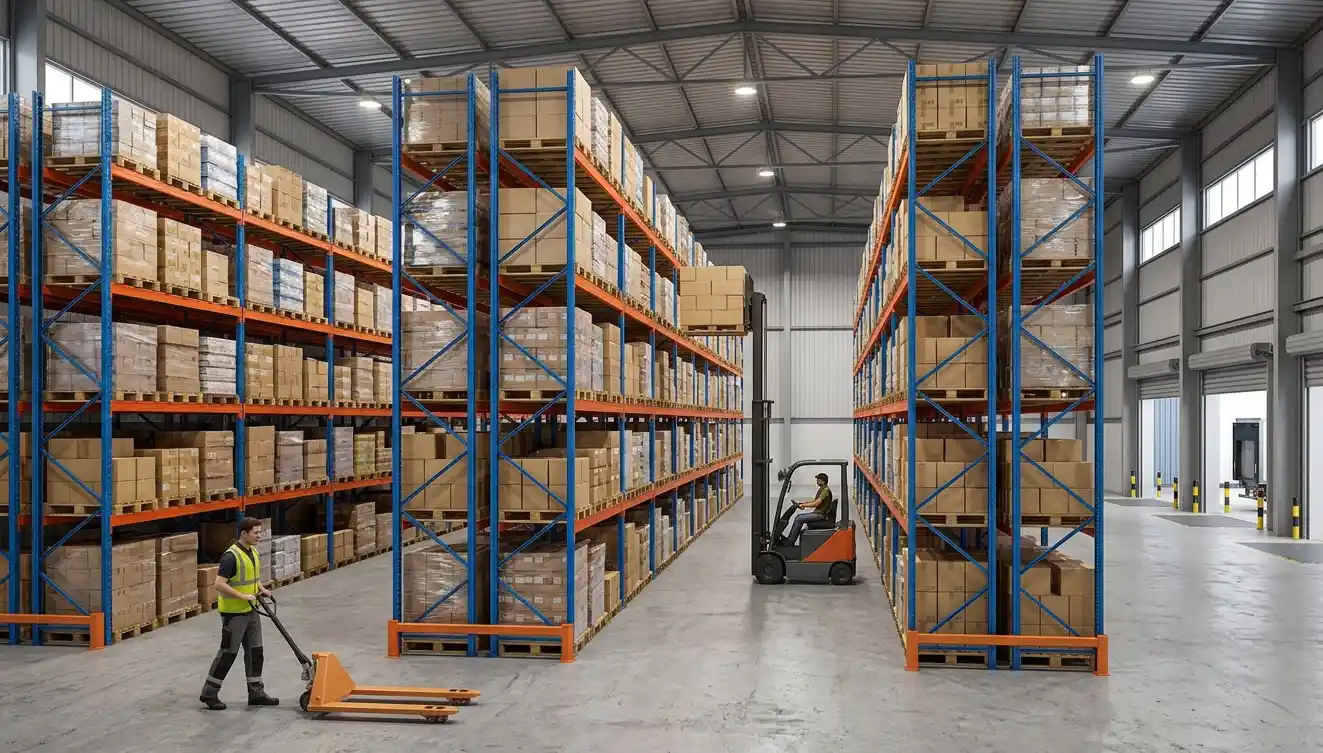
To define it simply, what is selective racking? It is the most widely used storage configuration in warehouses globally. At its core, it is a system designed to provide direct access to every individual pallet stored, eliminating the need to move one pallet to reach another.
Think of it like a massive, industrial-scale library: you can pull any “book” (pallet) from any “shelf” at any moment. The structure consists of vertical upright frames and horizontal beams, which are adjustable to accommodate various pallet sizes and weights.
Why the Term “Selective”?
The name is derived from its greatest competitive advantage: 100% selectivity. In higher-density systems, you might have to remove several pallets to reach a specific one. With a selective system, the operator has the total freedom to “select” any load immediately.
Technical Structure: The Core Components
The reliability of a selective system depends on high-quality engineering. A standard setup from Zawaya includes:
Upright Frames: The vertical columns that bear the total vertical load.
Load Beams: The horizontal members where the pallets actually rest.
Safety Accessories: Pallet supports, wire decking, and row protectors to ensure forklift safety.
What are the Different Types of Pallet Racking?
While selective racking is the baseline, the industry offers several variations:
Double Deep: Stores pallets two-deep to increase density.
Drive-In Racking: Forklifts enter the rack rows (High density, low selectivity).
Push Back: Operates on a Last-In, First-Out (LIFO) basis.
Radio Shuttle: The semi-automated bridge between high density and high speed.
Comparing Selective Racking to Other Types
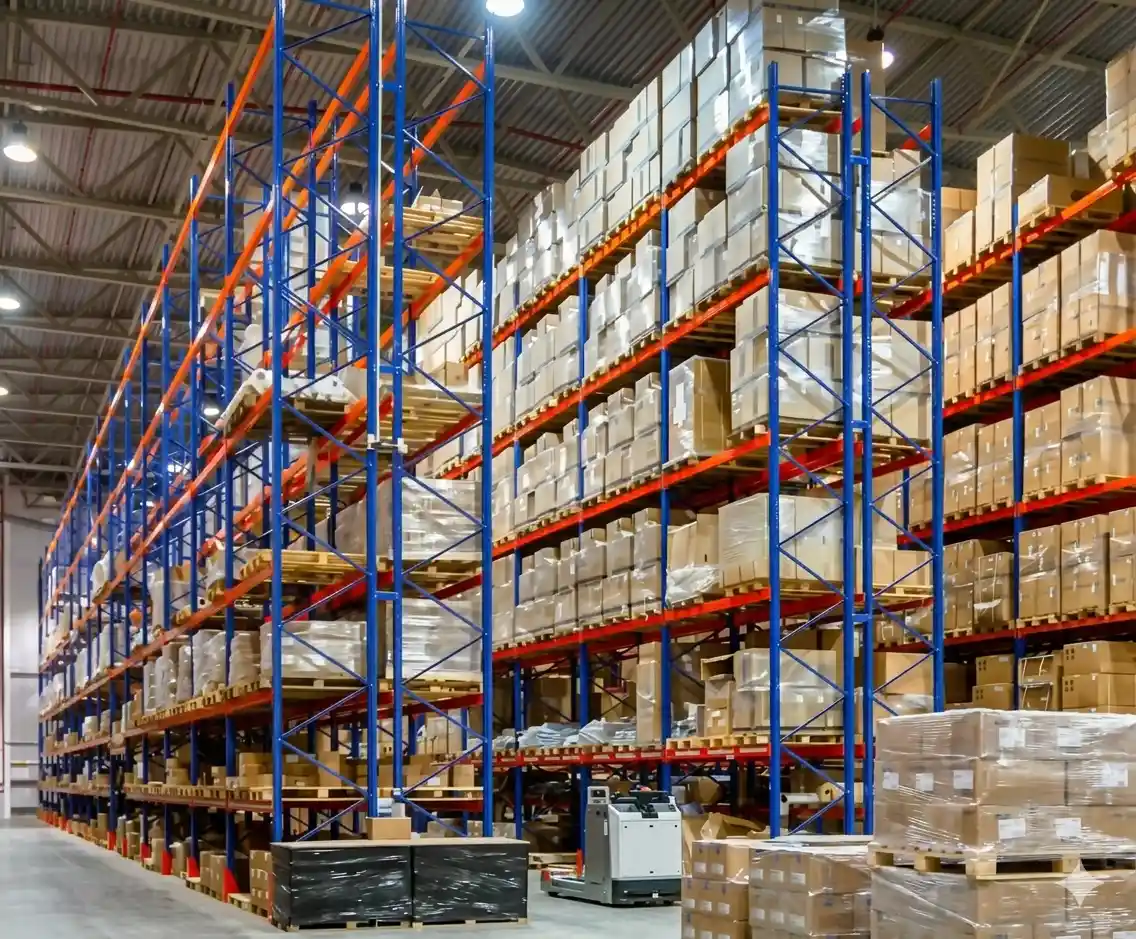
Business owners often struggle to choose between flexibility and density. Here is how selective systems stack up against Drive-In options:
| Feature | Selective Pallet Racking | Drive-In Racking |
| Accessibility | 100% Direct access to every pallet | Limited (LIFO/FIFO constraints) |
| Storage Density | Moderate (More aisles required) | Very High (Fewer aisles) |
| Initial Investment | Most cost-effective | Higher cost |
| Inventory Type | Ideal for high SKU counts | Ideal for high-volume, low SKU counts |
Why Zawaya Excels in Racking System Design & Installation?
In a market crowded with “conventional shelving” options, Zawaya stands out by bridging the gaps that others often overlook. We don’t just sell a product; we provide an engineered solution that addresses common industry failures:
Eliminating Load Uncertainty: Many systems suffer from beam deflection or structural failure due to poor load estimation. At Zawaya, we perform rigorous structural calculations for every storage level, incorporating high Safety Factors to ensure system stability even under maximum capacity.
Solving the “Wasted Space” Dilemma: Competitors often rely on generic designs that waste vertical space or create aisles that restrict maneuverability. We custom-engineer your system based on your specific forklift specifications and actual floor plan to achieve up to 100% utilization of available height.
Safety is Not an “Option”: While others might only install the bare metal frame, Zawaya is committed to providing complete protection accessories—including upright protectors, beam safety locks, and wire decking. This prevents forklift impact accidents that cost companies thousands in equipment repairs and downtime.
Precision Installation & Alignment: The biggest gap in the market is poor installation leading to tilted racks. Our team utilizes laser-guided measurement tools to ensure perfect vertical and horizontal alignment, guaranteeing smooth, frictionless pallet entry and retrieval.
Is a Selective Pallet Rack System Right for Your Operation?
When evaluating what is selective racking for your own business, consider these factors:
Do you have a high number of different products? If yes, selective is your best bet.
Do you need instant access to any pallet at any time? Selective wins here.
Is your current budget focused on immediate ROI? Selective is the most economical entry point.
However, if you have fewer SKUs but massive quantities of each, moving toward a Radio Shuttle system will be the upgrade your business needs.
Frequently Asked Questions
How much weight can a selective pallet rack hold?
Weight capacity depends on the specific engineering and steel gauge used. Typically, beams are designed to hold anywhere from 1,000 kg to 3,500 kg per level. At Zawaya, we custom-engineer our racks to handle heavy-duty industrial loads.
Is it suitable for heavy-duty industrial use?
Absolutely. Modern pallet racks are manufactured from high-tensile steel and finished with durable coatings. This makes them perfectly suited for heavy manufacturing, cold storage, and large-scale distribution hubs.
Building a Smarter Warehouse
Choosing the right racking system isn’t just about buying steel—it’s a strategic decision that impacts your supply chain speed, staff safety, and long-term overhead.
Whether you need the simplicity and versatility of Selective Pallet Racking or the high-tech power of the Radio Shuttle, Zawaya stands as your technical partner. We don’t just supply racks; we design solutions that maximize your space and optimize your workflow.