
Industry News

Types of Automated Storage and Retrieval Systems: The 2026 Guide

types of automated storage and retrieval systems
August 17, 2026 Admin No Comments

What Is AS/RS Technology and How Does It Transform Warehouses?

An Automated Storage and Retrieval System (AS/RS) is an advanced warehouse automation strategy that integrates robotic mechanisms, racking structures, and intelligent management software to deposit and retrieve loads with high precision. Incorporating modern asrs technology allows industrial facilities to move away from manual material handling, driving operational throughput up while slashing labor-related delays and damage.

Transitioning from traditional forklift-based storage to fully automated ecosystems optimizes floor space utilization by up to 80% and brings inventory tracking accuracy close to 100%. To choose the right setup for your facility, understanding the distinct types of automated storage and retrieval systems is the crucial first step.

The 4 Levels of Warehouse Automation

  1. Manual / Basic: Operators rely on handheld RF scanners and standard forklifts.

  2. Mechanized: Integration of conveyors, sorters, and basic material transport lines.

  3. Semi-Automated Solutions: Utilization of high-density pallet shuttles guided by human operators.

  4. Fully Automated AS/RS: Fully integrated robotic cranes and shuttles managed directly by Warehouse Management Systems (WMS).

1. Heavy Pallet Handling Systems (Pallet AS/RS)

Heavy-duty pallet systems handle standard unit loads ranging from 1,000 kg to over 1,500 kg per pallet position, providing maximum structural stability at extreme heights.

Unit-Load Stacker Cranes (Unit Load AS/RS)

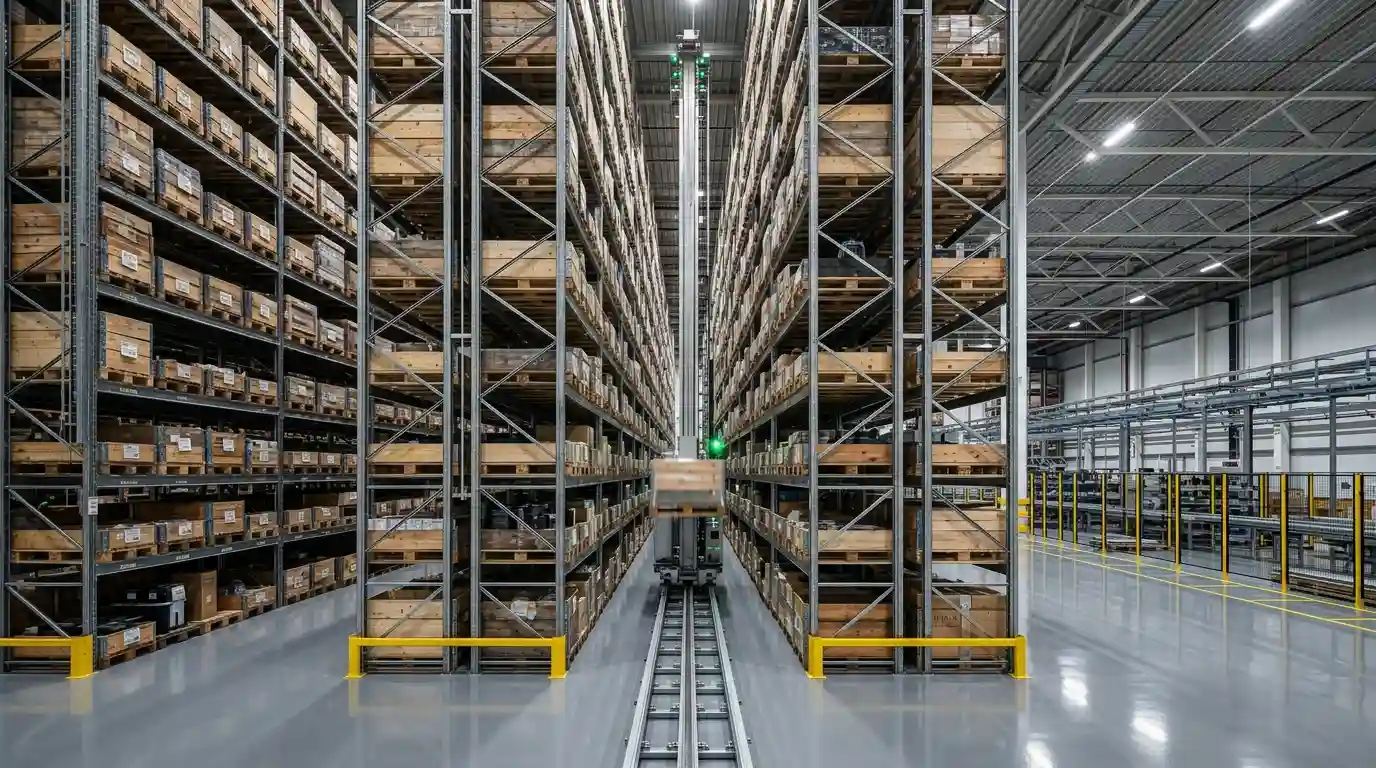
  • Overview: A unit load asrs utilizes specialized stacker cranes operating inside Very Narrow Aisles (VNA) to store and retrieve heavy pallet loads. These rail-guided cranes move simultaneously along horizontal and vertical axes at extreme heights exceeding 30 meters.

  • Best Used For: High-bay manufacturing facilities, cold storage centers, and high-throughput distribution hubs handling uniform heavy payloads.

Deep-Lane Automated Pallet Shuttle Systems

  • Overview: Combining a primary ASRS crane or transfer car with an autonomous satellite shuttle, this system drives deep into storage channels to store multiple pallets in a single lane (FIFO/LIFO setups).

  • Best Used For: High-density storage facilities with high volume per SKU, such as food and beverage cold-storage facilities.

2. Small-Load and Case-Handling Systems

When inventory consists of totes, trays, or individual cartons, small-load handling automation delivers unmatched picking velocity.

Mini-Load Stacker Cranes (Mini Load ASRS System)

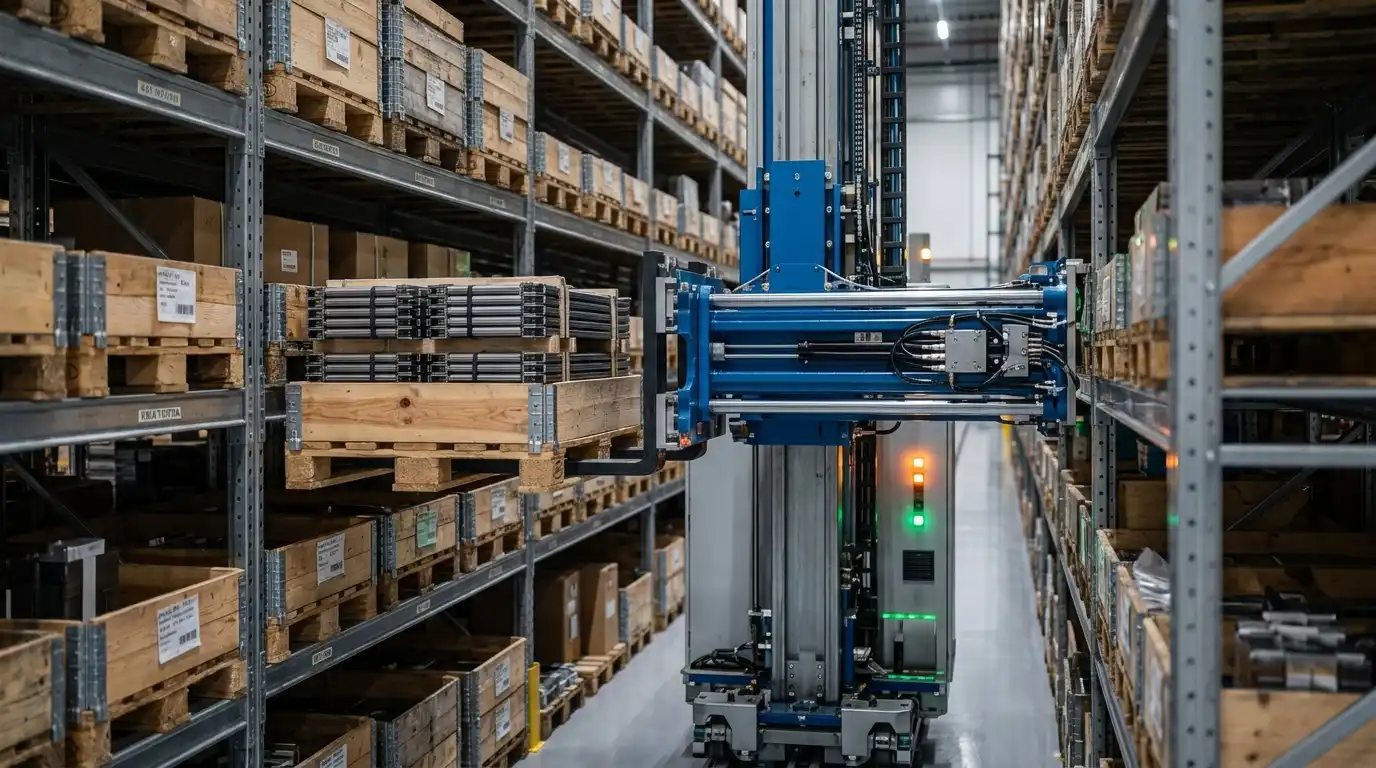
  • Overview: Designed for lighter payloads (25 kg to 300 kg), a mini load asrs system uses high-speed automated cranes equipped with telescopic forks or grippers to extract plastic totes or cardboard cases rapidly from high-density shelving.

  • Best Used For: Spare parts distribution, e-commerce fulfillment centers, and high-volume order picking operations.

Vertical Buffer Modules (VBM)

  • Overview: Enclosed, compact buffer systems designed for fast-paced order assembly. They serve as interim storage units that feed assembly lines or packing stations on a Just-In-Time basis.

  • Best Used For: Electronics assembly lines, pharmaceutical kitting, and interim buffer storage near production zones.

3. Dynamic and Vertical Goods-to-Person Systems

Dynamic systems leverage the “Goods-to-Person” concept, delivering required items directly to an operator’s workstation to eliminate unnecessary travel time.

Vertical Lift Modules (VLM)

  • Overview: An enclosed vertical cabinet housing internal tray storage and a central elevator mechanism. The VLM automatically measures payload height and positions trays to maximize vertical space utilization.

  • Best Used For: Maintenance workshops, tooling storage, and facilities with high ceiling heights but limited floor area.

Vertical Carousels

  • Overview: Operating on a “Ferris wheel” principle, vertical carousels rotate trays vertically along a closed track to deliver requested items to an ergonomically positioned access window.

  • Best Used For: Small hardware parts, automotive components, and sensitive document storage.

Horizontal Carousels

  • Overview: A series of bins or shelving units suspended from an overhead track that rotate horizontally along an oval path to bring items to the operator.

  • Best Used For: High-speed piece picking operations with low-to-medium item heights.

4. Next-Generation Robotic AS/RS Technologies

Driven by AI, dynamic routing, and modular designs, modern robotic solutions represent the cutting edge of flexible warehouse material handling.

Robotic Cube Storage Systems

  • Overview: Ultra-high-density storage built as an enclosed grid with no aisles. Autonomous robots travel across the top grid, digging down into columns to extract specific inventory bins.

  • Best Used For: E-commerce retail, apparel fulfillment, and high-density SKU environments.

Multi-Shuttle Robotic Systems

  • Overview: Fleets of independent 3D shuttles navigating structural racking networks across multiple levels simultaneously, providing exceptional throughput capacity.

  • Best Used For: High-volume distribution centers experiencing severe order volume spikes during peak seasons.

Autonomous Mobile Robots (AMRs / AGVs)

  • Overview: Un-tethered floor-based robots using LiDAR and AI navigation to transport mobile racks or heavy pallets directly to fulfillment stations.

  • Best Used For: Flexible warehouse environments requiring scalable automation without permanent floor infrastructure.

Key Categories: Types of Automated Storage and Retrieval Systems (Comparison Matrix)

System TypePayload TypeWeight CapacityMax HeightSpeed / ThroughputSpace SavingsPrimary ASRS Solutions
Unit Load AS/RSFull Pallets1,000–3,000 kgUp to 45 m30–60 pallets/hr60%–85%Bulk Heavy Storage
Mini Load ASRS SystemTotes / Cases25–300 kgUp to 20 m100–250 cases/hr50%–70%High-Speed Tote Picking
Vertical Lift Module (VLM)Trays / PartsUp to 1,000 kg/trayUp to 18 m120–200 picks/hr75%–90%Small Parts / Tooling
Robotic Cube StorageBins / BasketsUp to 35 kgUp to 12 m300–800 picks/hr80%–95%E-Commerce Fulfillment
Autonomous Mobile RobotsRacks / Pallets100–1,500 kgFloor LevelHighly Flexible30%–50%Scalable Dynamic Routes

Need Help Selecting the Right AS/RS Configuration for Your Facility?

Engineering a high-bay warehouse requires precise load calculations and spatial planning. Our technical experts at Zawaya provide customized consultations to analyze your SKU profile, ceiling height, and throughput targets.[ Request a Technical Consultation ]
asrs technology

How to Choose Between the Types of Automated Storage and Retrieval Systems?

Selecting the right industrial setup requires evaluating core operational parameters:

  • Step 1: Identify Payload Type

    • Option A: Heavy Pallets

      • Evaluate Ceiling Height:

        • Height > 15m: Deploy Unit Load AS/RS

        • Height < 15m: Deploy Pallet Shuttle

    • Option B: Totes & Small Parts

      • Evaluate Required Picking Velocity:

        • Ultra-Fast Throughput: Deploy Robotic Cube / Shuttle

        • High Density & Small Footprint: Deploy Mini Load / VLM

  • Payload Dimensions & Weight: Palletized goods mandate heavy-duty unit load asrs configurations, whereas small components benefit from a mini load asrs system or vertical carousels.

  • Facility Height Availability: Vertical clearance above 15 meters warrants tall crane-based asrs technology to maximize vertical volumetric storage density.

  • SKU Diversity & Velocity: Operations with thousands of individual SKUs require high-speed “Goods-to-Person” systems like robotic shuttles or vertical lift modules

Ready to Optimize Your Storage Footprint and Cut Operational Costs?

Whether you are designing a new high-bay distribution center or retrofitting an existing warehouse, Zawaya delivers end-to-end automated racking and stacker crane systems built to international engineering standards.[ Request a Custom Quote Today ]

Software Integration (WMS/WCS) and Site Infrastructure

Executing successful warehouse automation requires coordinating hardware capabilities with software infrastructure:

  • Floor Tolerances & Load Capacity: Super-flat concrete slabs engineered to international standards (e.g., VDMA, EN 15620) are necessary to prevent mast tilting in high-bay installations.

  • WMS & WCS Coordination: The Warehouse Management System (WMS) manages inventory records and order routing, while the Warehouse Control System (WCS) translates commands into mechanical motor movements for cranes and shuttles.

Frequently Asked Questions 

What determines the automated storage and retrieval system price?

The automated storage and retrieval system price depends on several variables, including total vertical height, load capacity per position, system throughput requirements, number of storage aisles, and software customization. While basic vertical modules start at lower capital expenditure levels, large-scale unit-load crane installations require broader initial investment offset by rapid labor and space savings (typical ROI within 2–4 years).

How do I evaluate different types of automated storage and retrieval systems for my facility?

To evaluate the types of automated storage and retrieval systems, begin by auditing your current SKU dimensions, required hourly picking rates, available vertical ceiling clearance, and long-term expansion goals. Matching your payload profiles against system-specific weight limits and throughput speeds ensures you deploy the optimal asrs solutions for your supply chain.

What is the primary difference between a unit load asrs and a mini load asrs system?

A unit load asrs is specifically engineered to handle large, heavy pallet loads weighing over 1,000 kg using heavy-duty stacker cranes. In contrast, a mini load asrs system is designed for high-speed handling of smaller totes, cartons, or trays weighing under 300 kg within narrow shelving aisles.

Is modern asrs technology compatible with existing ERP systems?

Yes, modern asrs technology relies on a Warehouse Control System (WCS) layer that interfaces directly with major enterprise WMS and ERP platforms (such as SAP, Oracle, or Microsoft Dynamics) to provide real-time inventory tracking and automated order dispatching.